
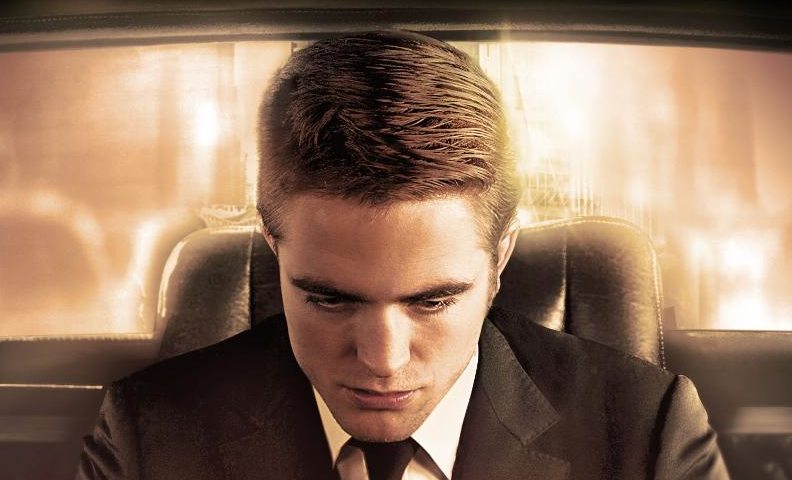
 Based on a novel by Don DeLillo, Cosmopolis is morosely immersive in its condemnation of the Wall Street uber rich. Personified by Eric Michael Packer (Robert Pattinson), the film explores the growing disconnect the 28-year-old asset manager encounters with his surroundings, his wife, sex and his fortune.
While the direction is admirable and classic Cronenberg, what’s missing is the empathy of Eastern Promises and psychological fascination of Crash—two landmark Cronenberg successes. In the wake of our recent financial collapse, Cosmopolis presents us with nothing new: yes, Wall Street can be evil; yes, the rich are self-absorbed, disconnected and cold; yes, if we continue down this path, there will be riots in the streets. The freshness here is only in the direction, not in the narrative or dialog.
The film is shot almost entirely in a corporate stretch limo, fully equipped with financial readout screens showing Packer’s second-by-zeptosecond financial demise. His two consultants–Jay Baruchel and Philip Nozuka–mouth phrases intended to be deeply incisive, but are instead, vacuous and often childish. His chief theoretician, Vija (Samantha Morton) prattles on about capitalism while his doctor administers a prostate exam to a nude Packer, a scene that verges on the ludicrous.
 Underscoring Packer’s emotional abandon, his passionless sex with friend Didi (Juliette Binoche) takes place while she offers to locate a Rothko painting to complete his collection. His insistence on acquiring the entire church, intended to communicate the gobbling up of art as investment, seems cliched. The only reactive sex Packer appears to enjoy is a face-to-face encounter with an attractive security guard, who shocks him with a 100,000-volt taser.
Outside, a presidential motorcade, a rap star’s funeral and anarchist riots have placed the city in traffic gridlock. The limo crawls past demonstrators wearing rat costumes—a metaphor for the world currency’s supposed demise from Yuan to rats.
When the limo pulls alongside a taxi, Packer steps into the cab to talk to Elise (Sarah Gadon), his wife of 22 days. The chasm that separates them is aptly revealed when she notices for the first time that Packer has blue eyes. Later, in a cheap diner, Packer comments on Elise’s stand-up breasts with as much emotion as he does cutting up his meat. The conversation is cold and disconnected as he entreats her for sex while she suggests that he is a dangerous person, “turning information into something stupendous and awful.” Their meetings continue in various venues with conversations that are as elliptical as they are deadpan.
Conversations with Packer’s barber are revealing if not bizarre, communicating as much about the ordinary citizenry of this financial Gotham as they do about Packer’s past and parents.
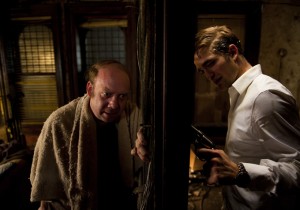 The film ends apocalyptically when a gun wielding Packer encounters gun toting Benno Levin (Paul Giamatti) in a warehouse. Both wax on about the self-destructive vortex of capitalism and other Shaman-like meaning of life metaphors. Here, Cronenberg respects the viewer enough to allow various endings to be self-interpreted. For a film so engrossed in its own tactility, Cosmopolis often fails to make human contact.

Alex A. Kecskes is a published author of "Healer a Novel" and "The Search for Dr. Noble"—both now available on Amazon. He has written hundreds of film reviews and celebrity interviews for a wide variety of online and print outlets. He has covered red carpet premieres and Comic-Con events for major films and independent releases.