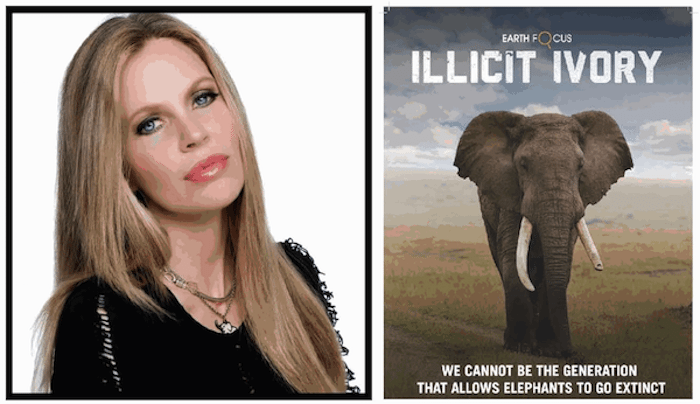
Kristin Bauer Van Straten (Once Upon A Time’s Maleficent and True Blood’s Pam De Beaufort) will introduce viewers to a special installment of American television’s environmental investigative series, EARTH FOCUS: Illicit Ivory. An animal rights advocate, Van Straten hopes this documentary will help viewers understand the dire situation that elephants face—that poachers kill an elephant every 20 minutes to feed an insatiable demand for ivory. As a result, African elephants may be gone in as little as ten years. In this one-on-one interview, Van Straten reveals her commitment to saving these regal animals and her passionate pursuit of animal rights.
You’re a long time animal rights advocate. What prompted you to become involved with this particular documentary?
Kristin Bauer Van Straten: I had no idea this was going on. I met with James Isiche from IFAW (international Fund for Animal Welfare). They do great work in Kenya and he told me this was happening. I was so stunned. I’d heard about the ivory crisis in the 80s, but I didn’t realize that ivory was such a widely traded commodity. The cruelty of it is astounding. Elephants are massive and majestic creatures. The slaughtering of these 15,000 pound animals for four percent of their body for a trinket is appalling. I spent a month with elephants in Kenya where we met Cynthia Moss, who had conducted the longest running study of elephants in the wild. She’s observed their family structure, bathing rituals, their birthing and mourning process. I read her book, and there’s just no disputing that they are as sentient as we are.

What were the major challenges in filming this documentary?
Van Straten: Kenya is the only country that has chosen to destroy their seized ivory—as opposed to selling it to China. The biggest problem we’ve seen since the total ban on ivory in the 80s is that other African countries are choosing to enter the black market, become traders and profit from the sale of illegal ivory. Most people in China don’t realize that an elephant had to be killed for their ivory trinket. The word ivory in China translates into “teeth.” Ivory has become a status symbol there; it’s how the Chinese middle class show “they have arrived. And that has fueled this drive to move ivory overseas again. We’re trying to get an all-out ban on ivory, but we’re getting all kinds of blowback from the people who would profit form its sale.

How long have you been involved in animal rights? And in the protection of elephants?
Van Straten: Throughout my life on some level. My dad was such a nature lover. While my siblings aren’t into animals like I am, they are into the environment. I became actively involved, and as my career rose, so did my opportunities to give back. There are so many amazing causes. And since I can’t clone myself, I try to get involved with the most voiceless—and that’s animals. I wasn’t involved in the protection of elephants until about three years ago. I didn’t go to the circus. I don’t believe in slavery. I’m not fond of using animals for entertainment. I’m an entertainer and it’s rough. I think it should be your choice. So I wasn’t aware of the elephant genocide until a few years ago. Lions, zebra, giraffe—all being slaughtered. Many animals in Africa are under siege, mainly from Asia.

What are the short and long-term goals you hope this documentary will achieve?
Van Straten: From what I saw in Kenya, the people there are astoundingly optimistic. I think it’s just their nature, but I also think that when you’re on the ground, literally saving lives, even if you save less than you’d like, there’s a certain can-do attitude that comes from having your hands in the dirt. And that optimism became infectious. The more who get involved, the greater chance we have of keeping elephants on Earth. I watched two animal species go extinct in the last two years, which is very sad. I asked a ranger in northern Kenya what will happen if more people don’t get involved in saving animals and he said it’s uncertain. The only thing we can do is try to support what these heroes in Kenya are doing.
How can people help this noble cause?
Van Straten: Depending on the person’s resources, if all they have is a voice, that’s huge. We need the world to declare an all-out ban on ivory. We need to spread the word as fast as we can. Many people hear about this and make the choice—to write a letter, foster a baby elephant in Kenya, send $50 to one of the organizations that I know will make a difference (they’re on my website).
Switching gears, what are some of your favorite moments in Once Upon a Time?
Van Straten: I usually watch the show, but I don’t like to watch myself. I really had a ball with Lana Parrilla and the rest of the cast. Lana is the first person I got to work and she has this amazing big laugh. The hours are really long, but we just dove in and had so much fun playing with these roles. I just came off seven years playing evil characters, and she has been killing it, playing evil. But now both of our characters have found a softer side.
EARTH FOCUS: Illicit Ivory airs on KCET. The program will also be available on http://www.kcet.org/ivory and KCET.org/ivory. The trailer can be seen on http://bcove.me/slkmg39e (warning: contains shocking footage of killed elephants).

Alex A. Kecskes is a published author of "Healer a Novel" and "The Search for Dr. Noble"—both now available on Amazon. He has written hundreds of film reviews and celebrity interviews for a wide variety of online and print outlets. He has covered red carpet premieres and Comic-Con events for major films and independent releases.