






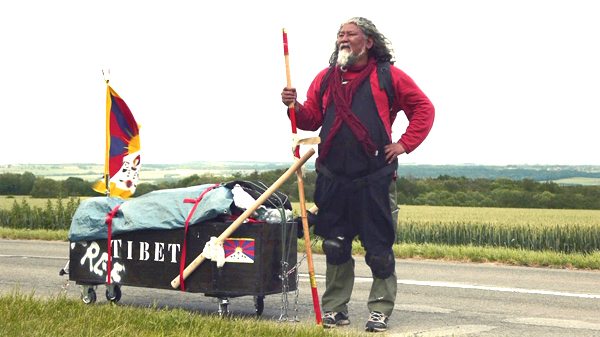

The documentary movie Tibetan Warrior offers a look at the plight of the people in a region taken over by the Chinese. The movie brings to light the disturbing practice of self-immolation as a way of letting the world know that Tibetans are opposed to Chinese rule. The film follows Loten Namling a musician and self-acclaimed Tibetan Warrior who walked for days spreading the word about his people in Tibet. It also goes into the visits he has made to the Dalai Lama in India and the United Nations. It is an interesting topic and one that should be addressed worldwide in the vein of any repressed nation wanting to be heard.
With a camera crew following him, fifty-year-old Loten Namling decides to walk from Bern to Geneva in protest to Chinese rule of his home nation of Tibet. He pulls behind him a homemade coffin with the words Free Tibet. The Nearly 100 mile journey will take some 52 days of weather, finding shelter, visiting friends, and carrying his struggle to the people.

Under Chinese rule when the Peoples Republic of China incorporated the county some 60 years ago, Loten tells his struggle of oppression. The film incorporates most of his stops along the way and his “awakening” of the plight which he fights. He also shows some of the history behind the take over of Tibet and how many monks have taken their lives for the cause of being free from China. The film shows Loten in a conference with the Dalai Llama where he gets a personal one on one interview.

Bonus material shows more of his Dalai Llama interview and others that he had with Lukar Jam Tibetan poet and former political prisoner, and Johann Schneider-Ammann Swiss Economics Minister and others.
The film has not been rated by the MPAA but contains video of violence including immolation. Since we are not a political forum the film’s meaning and information are up to the viewer to make their own observations. The filming of his trek is extremely good showing an interesting view of the countryside, small villages, people and customs.
FINAL ANALYSIS: A well-made production with a generous amount of information. (C+)
Specifications and additional video information:
Director and Cinematography: Dodo Hunziker
MPAA Rating: Not Rated, disturbing scenes
Genre: Documentary
Running Time: 1 hr. 25 min.
Video Release Date: October 9, 2015
Language: English
Reviewed Format: DVD
Audio: Stereo 5.1 Surround
Video: 16×9 full screen
Subtitles: English SDH
Number of Discs: 1 Disc
The region of Tibet maintained its autonomy until 1951 when, after the Invasion of Tibet, it became unified into the People’s Republic of China. The previous Tibetan government was abolished in 1959 after a failed uprising. The 14th Dalai Lama fled to India. Shortly after he established the “Tibetan Government in Exile”, known as the Central Tibetan Administration (CTA). The position of the CTA is that Tibet is a distinct nation with a long history of independence. – Derived form information presented from the filmmakers.