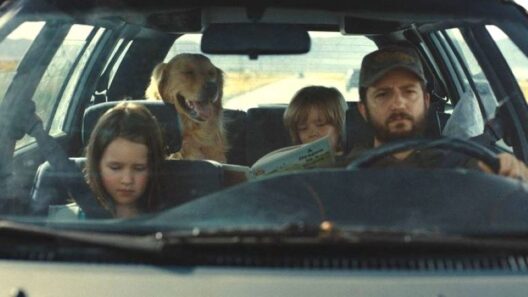


 As director and co-writer of the horror/drama Wake Wood, David Keating adds a unique style and vision to the horror genre. The film underscores the extremes to which parents will go to spend three more days with a daughter they lost to a violent dog attack. In this one-on-one interview, Keating reveals how he approached the film, the creative tools he employed, and the metaphorical references he used to convey Wake Wood’s sinister undertones.
Where did the idea for Wake Wood come from? Were you influenced by the Monkey’s Paw? Steven King? Pet Cemetery?
That’s a question that I’m asked a lot. I was aware, when I first read the script by Brendan McCarthy, that it was resonant with stories warning about what you wish for. I hadn’t seen Pet Cemetery, but I had read “Monkey’s Paw” years ago, and Wake Wood just seemed thematically unique, so I didn’t worry about too close a resemblance to those stories. When people ask me, is this film about transgression or being mindful of what you wish for, I tend to say it’s not nearly as much about that as it is about how much we love our kids.
Why did you choose cattle for the motif of birth and death?
The film is set in Ireland’s countryside where horses and cows are valuable animals. So a working country vet deals mostly with farm animals. As a teen, I grew up in a dairy farm and my co-writer, Brendan—his father and my father—were both qualified veterinary surgeons. So it just seemed natural to use farm animals as a motif.
Why did you choose a period of three days for people to be reunited with the dead?
Three’s a magical number that crops up in all sorts of mythologies and religions. It’s a beginning, middle and end. It’s being young, middle aged and old. It’s birth, life and death as Timothy Spall’s character noted. So it’s a number used throughout history—why did Christ come back from the dead for three days? It’s the Trinity.
What was the metaphorical significance of the giant wind turbines?Were they the pagan guardians of Wake Wood? Its sinister heartbeat?
They weren’t in the original script. I was scouting for locations for a marker, something that would visually and dramatically establish Wake Wood’s boundary, something the audience would see and remember. I wanted it to be physical and clear. I had also been thinking of the return, the evolution of how we bring the dead back to life, which was originally conceived as quite nebulous and achieved through some sort of digital effect. But I soon realized that this story is about something that’s much more tactile and visceral. Those who work on a farm know that it’s muddy and dirty with machinery. So when I saw these large wind turbines, I saw them as an extension of farm machinery—dangerous, powerful, yet functional. Then I started to think about what’s turning these turbines—is it the wind, the force that’s in this place?
Why did you choose a teen girl to first foreshadow what might become of Alice?
That’s a really good question. I knew we had to have this scene between the Mary Brogan character and Louise; the fact they both had lost daughters seemed to give the two women more common ground. They would simply be more sympathetic to each other.
Why did you go for the almost Alfred Hitchcockian ending–where Patrick Daly seems to turn the tables on Wake Wood’s pagan rite in a bizarre sort of way?
At that point in the film, we’re unsure about what’s going on. What happens to Patrick’s wife is unconventional, so we really don’t know what the rules are at that point. They change the rules because Patrick’s got some leverage with the town, since he’s a veterinary surgeon. We get the feeling that his wife is complicit in what follows. As my father used to say, “You can always give the hangman a kick on the shins on your way upstairs.”
Your previous works were basically comedies and documentaries. Do you plan on pursuing the horror/thriller genre?
I love horror films. I’ve tried to do them before but we just couldn’t get the financing. This is the first horror film I’ve had a chance to make, so I’m looking forward to making more of them.
Anything in the pipeline that we can look forward to?
Brendan McCarthy, my co-writer and producer onhas written a script called the Cherry Tree, which is like a companion piece to Wake Wood but it’s set in suburbia. It’s more teen oriented about a father and daughter.

Alex A. Kecskes is a published author of "Healer a Novel" and "The Search for Dr. Noble"—both now available on Amazon. He has written hundreds of film reviews and celebrity interviews for a wide variety of online and print outlets. He has covered red carpet premieres and Comic-Con events for major films and independent releases.