


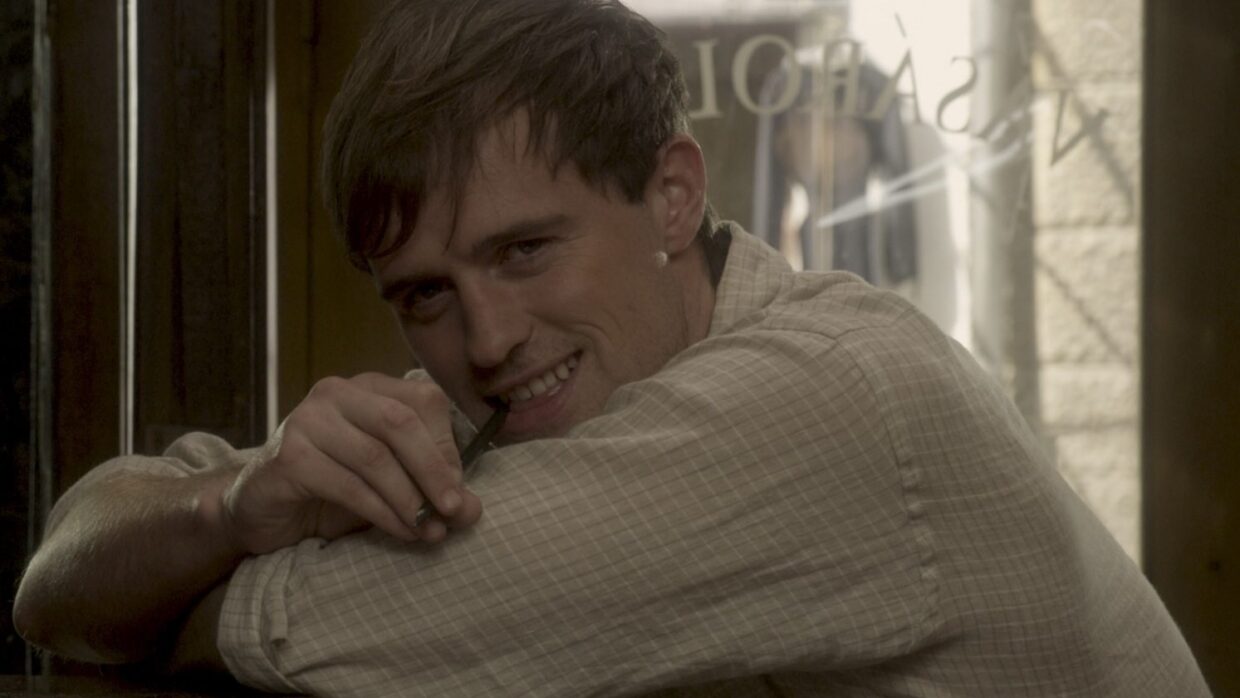
A graduate of the Royal Academy of Dramatic Art, Irish born Jonas Armstrong has amassed an impressive body of work, highlighted by leading roles in such diverse TV series as Robin Hood, Hit & Miss, and Prisoners Wives. He has also appeared in such highly acclaimed films as The Whale and Twenty8k. In Walking with the Enemy, Armstrong plays Elek Cohen, a heroic Hungarian Jew caught in the maelstrom of Nazi cruelty during the final months of World War II. Inspired by a true story, Walking with the Enemy underscores the courage and sacrifice made by brave Hungarians who donned stolen pro-Nazi uniforms to reroute Jews to safety. In this one-on-one interview, Armstrong reveals his passion for the film and the challenges he faced in portraying such a heroic figure.
What attracted you to Walking with the Enemy?
Jonas Armstrong: It was a brilliant script with a brilliant character, based on real events, which I learned when I met with the director (Mark Schmidt). Just the extraordinary lengths Elek went to in putting his life on the line, day in and day out. He and his friends risked their lives on a daily basis. They were the “small people” in this situation, and they took it upon themselves to do what they could do.
Did you audition for the role? If so, what was that like?
JA: I read two scenes with Hannah Tointon. Then I did the scene with Mark Wells where I said that I had nothing left—they’ve taken everything from me, everything I’d loved and known was all gone. Mark and I then discussed the history of the story, and the plight of these Hungarian Jews at the end of the Second World War.
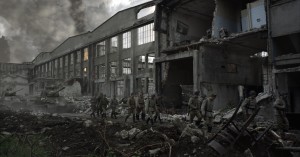
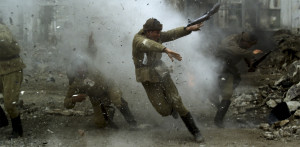
Walking-with-the-Enemy-Russians-March-In
How much research did you do on Tibor Rosenbaum, the Hungarian Jew who inspired the film? Did you talk to any Hungarian Jews before or during filming?
JA: I did as much as I could in the three weeks before primary shooting began. But I was very fortunate in that I had spent the better part of three years living in Budapest filming Robin Hood for the BBC. I had walked past the Glass House, probably a hundred times. I’ve always been interested in the World Wars. When I took my first long weekend, I returned to Budapest to visit the Glass House. And that was a completely different experience for me. I realized that the holes in the wall of the Glass House were created by bullets fired by Soviet and Nazi soldiers. On Andrassy Street, there was the House of Terror, which serves as a constant reminder of the Nazi occupation and the Soviet’s arrival.
What part of the role did you find most challenging?
JA: I felt it was very important to have the right energy level going into every scene. I had to be very buoyant and focused. I had to keep the part very alive and very alert because that’s one thing I wanted Elek to be. He didn’t plan this. It just happed to him. These things were borne to him by chance and I wanted to make that very evident in the character. The fact that he had to be a quick thinker and always alert was a key element of the character. Even though I may only have had a few lines in a scene, I wanted to keep the tension as high as possible.
The scene where you were ordered to shoot Jewish Hungarians—even some women and children—was particularly powerful. How did you prepare yourself emotionally for that?
JA: It was demanding and tiring. Before those scenes, I had to take some time and just sit in my room. I tried to keep myself very focused. You have to be ready for these emotional scenes. You can’t just pop on a façade or mask and try to pull it off.
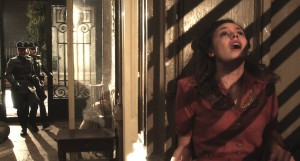
The film obliquely parallels Schindler’s List in depicting the saving of Jews by deception. How do you see these parallels?
JA: Of course, there will be parallels to that film. But this film is not set in Poland; it’s set in Hungary. It’s a similar story but in some respects, it’s the same story with different people in a different place. It’s treacherous territory when you try to portray what happened during the Holocaust. You have to treat the subject with great delicacy, so I hope it comes across with the right intentions.
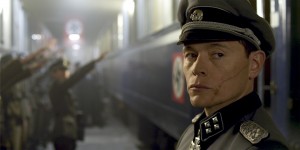
The difference between the two films is that Elek was always in imminent danger, which is something we see in his face and demeanor.
JA: That’s what I was constantly trying to portray. People don’t look cool when they’re in danger or scared. They look stupid, which is what I wanted to convey. I wanted to make it as real and as visceral as possible. These were young men thrown into this plight. They weren’t warriors or soldiers. Their main priority was getting through school, getting women, drinking and enjoying life. The war was chucked on them, so they had to summon the courage to do what they did against a really ferocious machine that had descended upon them.
Where did most of the filming occur?
JA: It was primarily in Romania.
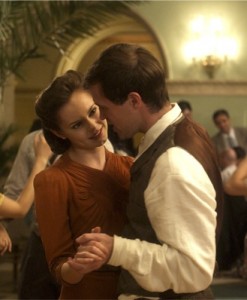
The chemistry between you and Hannah Tointon was evident throughout the film. Had you worked with her before?
JA: No, I hadn’t. It was great to work with her. It was pretty obvious when Hannah came in and I read with her that she was the one for the part. She’s a lovely girl and a great actress.
What should viewers take away from the film?
JA: That it was only recently that these atrocities took place. It was real and relevant and will always be relevant.
Fans will be asking about your next film, Edge of Tomorrow. What can you tell us about it?
JA: People have compared it to a war-science fiction version of Ground Hog Day. Only because the day keeps repeating itself. It’s a roller-coaster ride. It’s going to be a blast and I’m really excited about it.

Alex A. Kecskes is a published author of "Healer a Novel" and "The Search for Dr. Noble"—both now available on Amazon. He has written hundreds of film reviews and celebrity interviews for a wide variety of online and print outlets. He has covered red carpet premieres and Comic-Con events for major films and independent releases.