

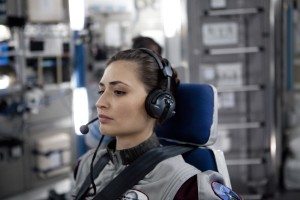
Employing the suspenseful found-footage format used in horror films, Europa Report details—in the most scientifically accurate sequences ever filmed—a manned mission to Jupiter’s moon, Europa.
Suspecting life under Europa’s ice-covered oceans, scientists played by Michael Nyqvist, Sharlto Copley, Daniel Wu, Karolina Wydra, Christian Camargo and Anamaria Marinca face the boredom of prolonged space flight as well as the unforgiving lethality of space exploration. In this roundtable interview, actress Karolina Wydra, director Sebastian Cordero, and producer Ben Browning reveal their passion for this film and the many challenges they faced in bringing it to life.
What was it like working in such a claustrophobic set with eight cameras running simultaneously? Had you ever done anything like that before?
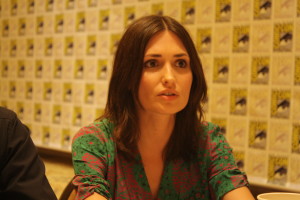
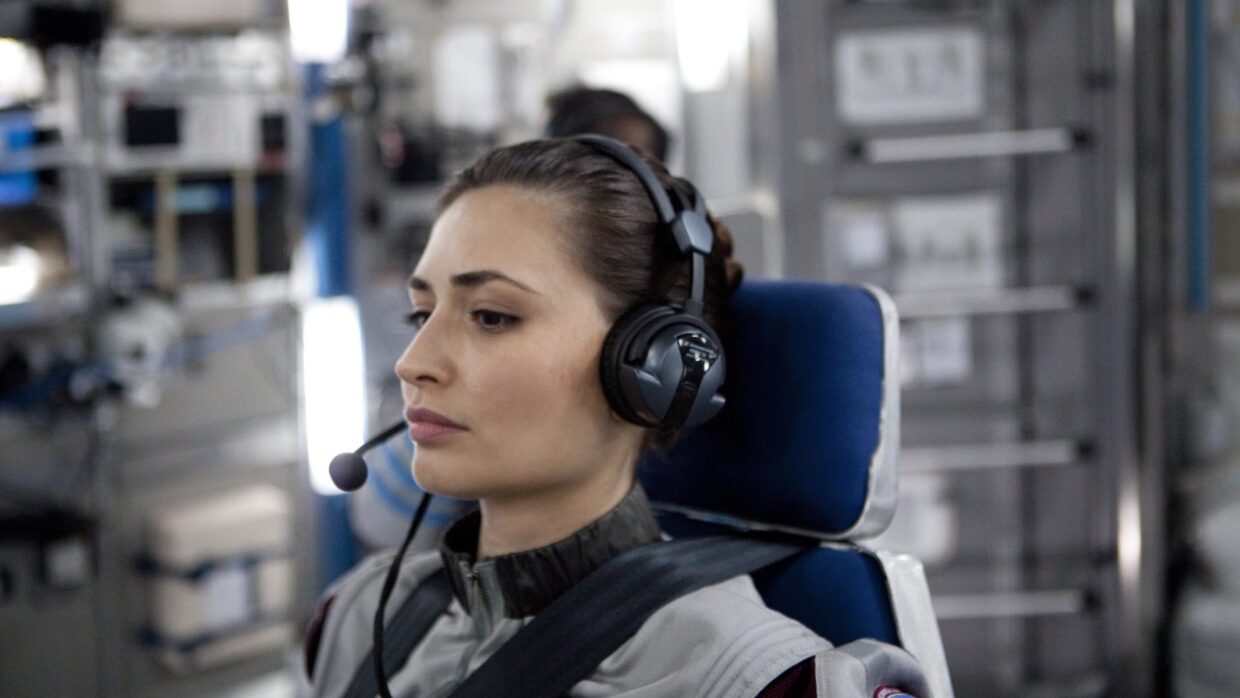
Karolina Wydra: I’ve never done anything like that and I don’t think I ever will. Although, that’s another thing that drew me to the project–wondering how they were going to do it. I said, wow, I’ve never heard of that being done. I think being in the ship, closed off and in that claustrophobic environment added to the authenticity of our performance. You knew where the cameras were but there was no one else around except for the actors inside the ship doing the scene.
Were you interested in this type of material before you accepted the role?
Karolina: I like science and the biggest thing that drew me to this project was the character. It was Katya’s strength, her courage, and her passion for research and love of discovery. She’d never been to space and when she got the opportunity to go, she jumped on it. Going on that journey, I knew would be challenging because it’s so far removed from who Karolina is—I’m not a scientist, I’m not a marine biologist. Doing the research and finding the character was something I was super excited about.

(photo by Alex A. Kecskes)
How did you prepare for the role?
Karolina: We had two weeks of rehearsal before we started shooting and I talked to marine biologists. I also read a lot of books on oceanography to try to understand the basics of this science. There were many discussions with the cast in breaking things down, and how people behave in space and how they behave when something terrible happens. Another thing I love about this film is how these scientists react to peril or the unknown. When I watch sci-fi films, people react in such a dramatic way when something unexpected happens, but that’s not how scientists react. They’ve been trained to specifically go through these moments of stress and not have these dramatic reactions.
What was it like making this film?
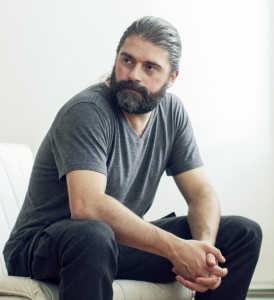
Sebastian Cordero: It was a big challenge, but extremely exciting. There is a childhood dream in all of us to play astronaut and to design a mission. I didn’t think it would happen in my career as a filmmaker, but the opportunity came and the script was good and the project was good, and things were coming together nicely. It was a short shoot and a very ambitious film with a modest budget for a lot of visual effects and everything looking good. You’re also dealing with a real subject—to go to Europa. So you don’t want to betray that ambition by portraying it in a way that wouldn’t do it justice.
Ben Browning: I’ll try to describe what the blueprint was: Based in real time, alternative history, all documentary, found footage, shoot in 18 days, in a spaceship we were going to build, eight cameras running at the same time, in New York. It blew people’s minds when we were trying to put it together. There were easier things to try but the objective was to take a crystal clear notion of what it would be like if we found life and extrapolate it. We’d talk to the JPL guys. And while we had some popular science working knowledge, it was a long way from, “give us a working scenario of how this could really happen.”
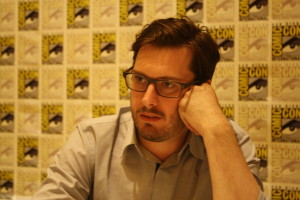
(photo by Alex A. Kecskes)
What was the coolest thing you did on set?
Sebastian: When we got to the last act, after the ship is distressed, it was interesting to see to what extremes we could take the ship and to reflect that via the cameras. From the very beginning, we talked about giving each camera a personality. How will this camera fall? How will that one break down? How will the focus stop working on another camera, and how much tension will that create? It’s a tool that in any other film, I would not use. Here, the deteriorating cameras worked great in the found-footage format.
What is it about the subject matter that attracted all three of you?
Sebastian: On my end, it wasn’t so much about space exploration, but simply about exploration. The fact that as human beings, we have that dream to explore more, to see what’s on the “other side.” There’s always that instinct to go further, and space exploration is really the epitome of that. It’s a situation where you’re really going into unknown territory. And Europa’s very seductive as a moon, a celestial body. It’s significant in our history in that for Galileo, it was the first moving body that wasn’t rotating around us but around another planet. Knowing that we’re not the center of the universe drives you forward.
There’s an image we see at the end of the film. How much more do you know about it than what the audience sees? Do you have a visualization of what else that image is?
Ben: I think it’s reasonable to say that they find a creature. Yes, extensive drawings were researched. And we talked to biologists to determine what it could be, where would it live, what would it do, the bioluminescence, the radiation. So, yeah, we have a pretty good idea of what we think it is.

Sebastian: There was quite a bit of research that led to that fictional probability. At the same time, from the very beginning, we said, it was going to be clear that we see something, but there was also a real value in not seeing more of it and in keeping that mystery, even to the point of not showing how large it is. You know it’s big, but is it way bigger? I thought, from the very beginning that it would be nice to have an H.P. Lovecraft kind of creature, but at the same time, there’s so many types of creatures here on earth, which gave us so much to play with. We felt that leaving some ambiguity was important for the film to work.
Karolina: That’s what I love about the ending. People sacrifice their lives for research and that the end was so much in your face. It leaves you with that mystery. They found something but it’s about the lives of these astronauts.
Ben: That was a big part of the creature, too. We knew that when they found something, they couldn’t be terrified of it. They wouldn’t hunt it down. Or shoot it.

Alex A. Kecskes is a published author of "Healer a Novel" and "The Search for Dr. Noble"—both now available on Amazon. He has written hundreds of film reviews and celebrity interviews for a wide variety of online and print outlets. He has covered red carpet premieres and Comic-Con events for major films and independent releases.