

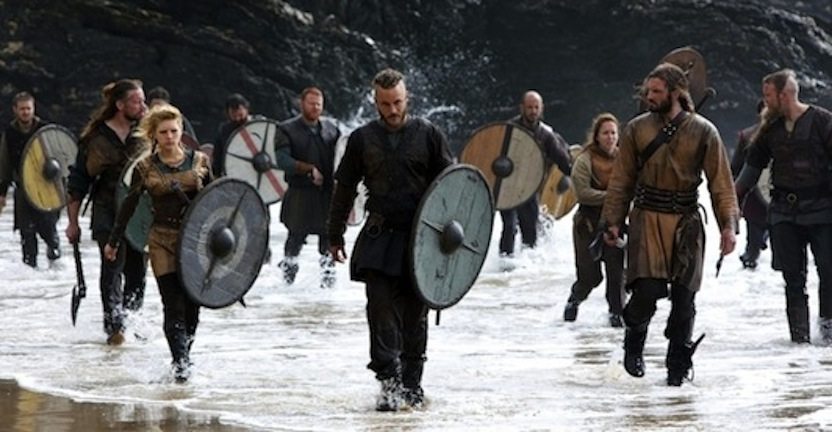

Created and written by Michael Hirst (Elizabeth, The Tudors), History Channel’s Vikings is packed with conflict, warfare and bloodshed. The family saga follows the adventures and conquests of Ragnar (Travis Fimmel) and brother Rollo (Clive Standen). Deeply frustrated by the unadventurous policies of local chieftain Earl Haraldson (Gabriel Byrne) and his wife Siggy (Jessalyn Gilsig), Ragnar and Rollo set out to invade the British Isles. Ragnar’s wife, Lagertha (Katheryn Winnick) keeps the home fires burning, fending off foes with admirable skill. Representing the conquered is Athelstan (George Blagden), a young, innocent Christian monk captured by Ragnar during his first raid on England.
In this roundtable interview, Katheryn Winnick, Travis Fimmel and George Blagden talk about their roles, adding their unique insights into what makes Vikings such a success.
You have a black belt in Tae Kwon Do and trained to become a licensed bodyguard. You basically knew how to toss guys around. Did you need special training for the role of Lagertha?
(photos by Alex A. Kecskes)
Katheryn Winnick: I play a shield maiden, a female warrior in the dark ages. I had to learn to use a shield and sword to both attack and defend myself. That was definitely new to me.
In the pilot episode, Lagertha gets into this huge fight with these two guys. Yet when Ragnar comes back and asks if she’s okay, she says everything’s fine. What was the reasoning behind that scene?
KW: Lagertha takes care of herself and her family. She doesn’t want her husband to worry. She can defend herself. She doesn’t need her husband to protect her. They have an equal relationship and that’s what great about their dynamic. He trusts her. And they respect each other.
In preparing for the role, did you look into how women of that era handled themselves?
 KW: There’s very little information out there, but Michael give us different resources and books about how women were portrayed in the Vikings and the Dark Ages. It was amazing to see how strong women were. They were not only mothers and warriors, but they could own land and divorce their husbands. It’s very empowering to know that women had a strong voice. In preparing for the role, I thought of Joan of Arc and Katherine the Great—both were strong, powerful independent women.
Can you tell us what’s going to happen with Lagertha’s relationship with Ragnar?
KW: Their relationship is definitely a love match. It’s a true partnership and an equal one. All I can say at this point is that they do struggle. As Ragnar becomes king of the Viking tribe, it brings a lot more responsibility and conflict that Lagertha has to deal with. You’ll just have to wait and see.
Are you typically drawn to strong female characters?
 KW: Yes, I love strong character roles, but I also love to explore both a character’s flaws and vulnerabilities. Michael does such an amazing job in Vikings. He wrote Elizabeth, so I trusted him and what he would do with my character. Lagertha is strong, yet she has her weaknesses. I remember thinking, where would Lagertha be most vulnerable? Is it with her husband, her children, or that she’s a woman in this environment? This gave me a lot to work with and sink my teeth into.
If you could add one new facet to your character in the next group of episodes, what would that be?
KW: I don’t think I could ever add to what Michael has written for me. He’s such an incredible writer; I’m in awe when I read the script. I did email him and ask him to feel free to challenge me as an actor. What I like about Lagertha is she does have so many layers. He wrote me back and hinted that there would be some meaty stuff coming up, so I’m sure he’ll put me through the ringer.
What was your audition like? Physical?
 KW: Nothing physical at all. I got the script in March and when I read it, I called my agent and said, I gotta get in on this. They weren’t doing any meetings so I had to put myself on tape in my living room. After a few months, I was in Toronto shooting something else and I got a call, saying that they wanted to see me again, but they weren’t sure I could pull off a Viking. So I rented what I thought was a Viking outfit from a costume store. Then they flew me to LA to screen test with Travis and three days later, I was in Ireland.
What’s it like shooting in Ireland?
KW: You’re in the middle of nowhere. There’s no cell reception or internet, so you’re stuck in an environment that forces you to relate and connect with the other cast members, which was so necessary for something like this, especially as the cast grows and different members come in from various countries. We’re sitting in a tent next to a heating device and it forces us to connect and bond, much like Viking families, who had a strong support system.
What Viking traditions have you learned being on the show?
(photos by Alex A. Kecskes)
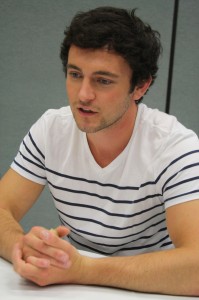
George Blagden: I’m still learning about them—I’m the monk. The great thing about the show is that Michael wants me to be the eyes of the audience. Athelstan is closest to the modern Western society that will be watching the show. The audience will learn a lot about Vikings through Athelstan’s eyes.
How did you prepare for the role? You had to learn about Vikings and 8th century Christianity at the same time.
GB: I purposefully avoided a lot of the lectures we got from Michael during pre-production week. I thought it would be more exciting to learn about the Vikings during shooting, as Athelstan does. I know the rest of the Vikings cast had rowing and sword-fighting lessons, and that they learned about Viking gods. But it’s all new for Athelstan, so if I’m doing scenes and I already know about all these fantastic Nordic gods, it’s not like being in the moment. If I’m doing a scene with Travis, I want to be surprised about the Viking gods.
What’s the most challenging aspect of your character?
 GB: I know it sounds silly, but it’s very challenging as an actor when people ask you to be yourself. Just before Vikings, I was filming Le Meserables in London and doing a character that’s very not me—a drunken womanizer who’s very confident and loud. Sometimes that’s a lot easier because it’s far removed from who you are. It’s hard when the director says we really want to see George as Athelstan. Bring as much of you as possible. You find yourself asking, what part of myself do you want me to bring?
It seems like Athelstan is staring to question his faith? Will he begin to embrace the Viking way of life?
GB: His character changes so much this season. And I hope that when you see his transition from the beginning of the series, you’ll wonder if that’s the same man. Even the most religious of men are still human, so keep watching.
 What do you think it is about Athelstan that kept Ragnar from killing him?
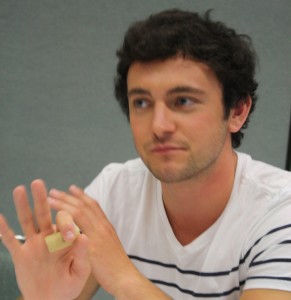
GB: Athelstan speaks his language and Ragnar thinks he might be useful to him. When he brings him home to Ragnar’s family, he realizes that saving him was a clever move. They’re drawn to each other, being from two different worlds.
What was the casting process like?
GB: I had the audition in London, in a fancy hotel’s underground chapel, in the basement. It was kind of weird—you’re a monk and you walk into this chapel.
Did it take you long to learn the Norse language?
(photos by Alex A. Kecskes)
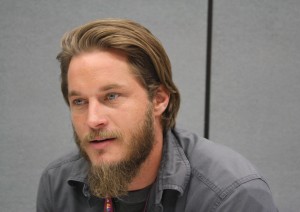
Travis Fimmel: It took me a long time. It’s certainly not my strong suit, especially for that scene on the beach where I had to speak English, Saxon, and Norse at the same time.
What do you think about the relationship between Ragnar and his brother?
TF: It really adds to the show, and our relationship gets better because we obviously love each other. We are brothers, but we have different views on the world and what should be done. It really comes to a head later in the season. It’s one of my favorite shows coming up but I’m so lucky the show’s doing so good.
Were you surprised to see how quickly the audience embraced the show?
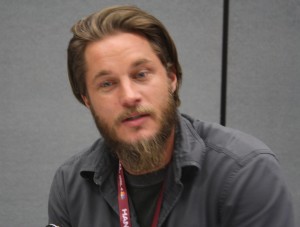 TF: Well, you hope people will like it. I enjoyed everyone I worked with and hope that it will be successful. I was really rooting for it, and the ratings have been great so I have no complaints.
How did you bring yourself up to speed on Viking lore and religion?
TF: Michael Hirst is amazing, and he has a wealth of knowledge. He knows about everything, so he gave me a lot of documentation to read.
Where do you think Ragnar got his ambition?
TF: Some people are just not happy with where they are. They want more, and to see more of the world. I think Ragnar would take any risk or sacrifice anything to acquire more knowledge. I’m sure a lot of it is just to be known and respected.
How did you prepare for the weapons training?
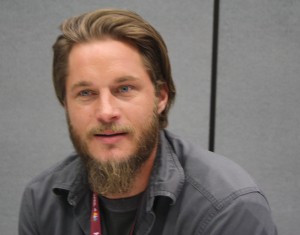 TF: I always chopped wood and always with axes. It was more for Native Americans back then though. You know, Native American tomahawks. I loved cowboy movies. We were always running around with tomahawks, me and my two brothers. But in Vikings, we had great stunt coordinators and choreographers, and they made it really easy. You get used to it, just like anything you work with, like a muscle. By the end of it, it comes a lot more naturally.

Alex A. Kecskes is a published author of "Healer a Novel" and "The Search for Dr. Noble"—both now available on Amazon. He has written hundreds of film reviews and celebrity interviews for a wide variety of online and print outlets. He has covered red carpet premieres and Comic-Con events for major films and independent releases.